
How to Start an Açaí Bar in Norway
Açaí has gone from being something people discovered on vacation to becoming a category of its own in the Norwegian food scene. We’re getting more and more calls from people who are considering opening a place that sells only açaí—in a shopping mall, in a food truck, as a small kiosk in the city center, or simply as a pop-up in connection with an event.
We sell açaí and machines, so we’re not impartial. But we’ve seen enough concepts launch, grow, and sometimes falter to know what tends to work and what tends to go wrong. Here’s what we’d say to a friend who asked.
Is there a market for that?
Short answer: Absolutely. The cake just keeps getting bigger and bigger.
About 120 Norwegian restaurants and cafes currently offer açaí bowls on their menus. The vast majority of them are cafes and juice bars where açaí is just one item among many—not dedicated açaí concepts. At the same time, international chains have begun to establish themselves in Norwegian cities, and new locations have received media coverage and drawn lines out the door.
That means two things for you. The category is popular enough that people know what they’re coming for—you don’t have to explain the product. And you won’t be alone, so your concept needs to have a reason to exist beyond “we have açaí.”
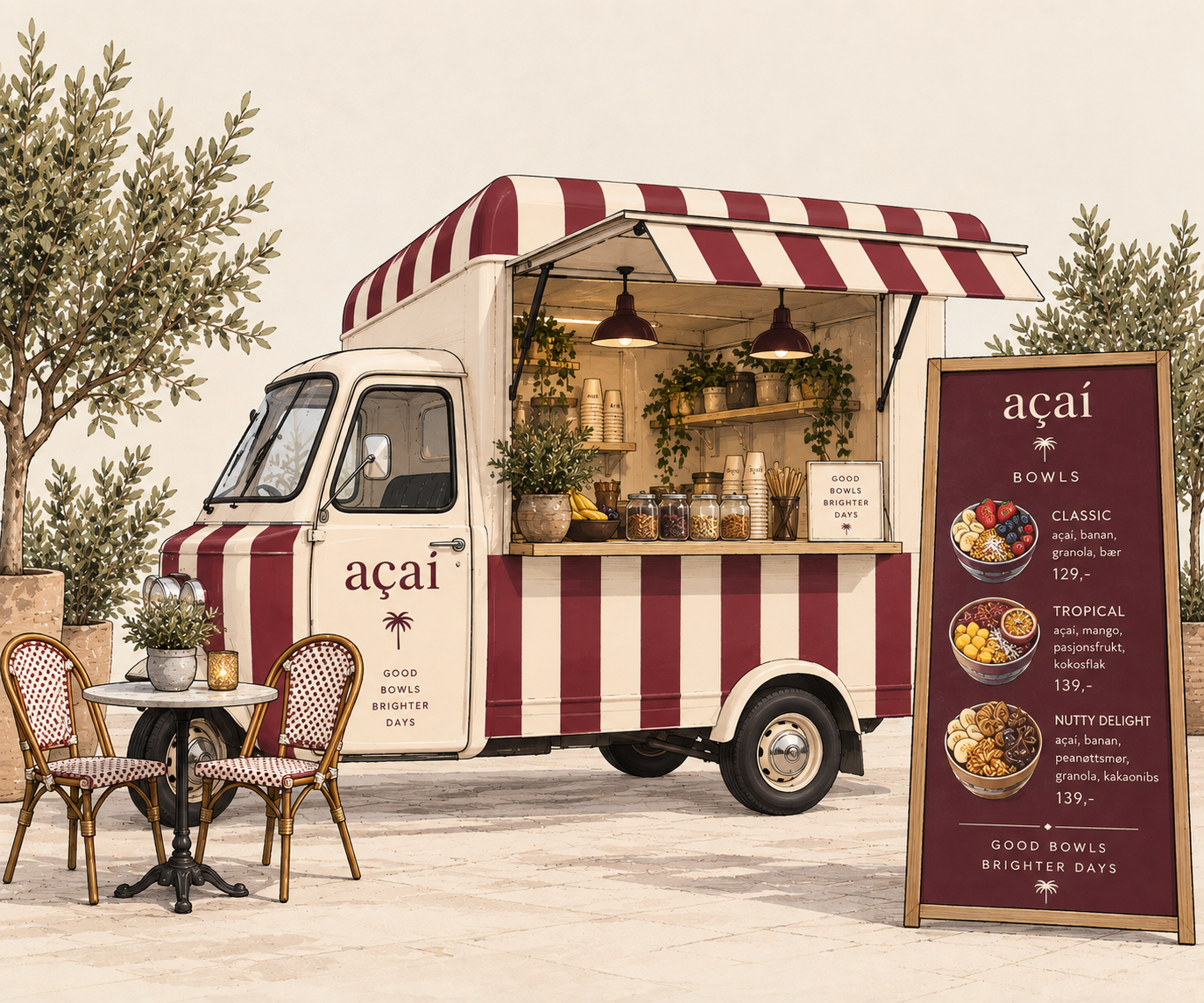
There are still few places in Norway that offer açaí, and it’s also easy to stand out even if there are several others selling açaí in your local market. In other words, it’s easy to stand out even if the raw ingredient itself is the same. Maybe you have a different food truck than your competitors, a different selection, and a different menu—maybe you stand out because of your prices, or because you have a machine? We’re not kidding when we say that an açaí stand’s revenue in a single summer can rival the full-year revenue of a large traditional kiosk, restaurant, or café—and the best part is that the stand ends up with a healthy profit once the books are closed. In other words: it’d be silly not to give it a try. Set up an açaí stand on the beach, at a playground, in a town square, at a pier, at a water park, or in an amusement park—or set up a pop-up for an event, a festival, or a market. The sky’s the limit—look for a location today, and start planning now for next season!
The prices are reasonable: an açaí bowl currently costs around 129–250 kroner, depending on the size and toppings. That’s a high price for a serving of frozen fruit, and that’s exactly why the business can stay afloat. Most of the time, it’s not just one customer at a time, but a group—and just like that, you’ve got 1,000 kroner in sales from “one customer.”
Decide on the concept before choosing the venue—and get a head start on social media
There are three ways to get in, and their costs vary greatly:
Pure açaí bar. Its own space, its own menu, with açaí as the core of its identity. Highest upside, highest risk, and the one that demands the most from you in the winter. If you tailor your concept to include drinks, after-work gatherings, catering/B2B, and meals, you’ll have the keys to success.
Açaí in an existing business. A café, restaurant, hotel, bakery, fitness center, kiosk, or juice bar that adds açaí to its menu. This is the easiest option to get started with, and by far the most common way to begin. Many people start here and discover that açaí becomes their best-selling item. At some point, you’ll switch to using a machine—or you’ll start with a machine right away and add more as demand grows.
Seasonal and event-based operations. Pure açaí bowls for the summer: at a beach, a playground, a hub, at a festival, as a beach kiosk, or a summer pop-up. Low fixed costs, but a short window to recoup all expenses.
The formalities—these need to be taken care of
You need three things before you can serve even a single bowl:
Become a customer of a wholesaler— ASKO, Servicegrossisten, or DLVRY—or contact us at Isdalen, and we'll find a solution.
Registration with the Norwegian Food Safety Authority. All businesses that prepare or serve food must be registered. The Norwegian Food Safety Authority has a separate starter kit for new food businesses that is worth reading before you do anything else.
A liquor license from the municipality. This requirement applies to all establishments where food is served and where arrangements have been made for dining on the premises—if you only offer takeout without seating, you are generally exempt. If you need a license, the general manager must first pass the business owner’s exam. The exam is administered by the municipality and costs about 400 kroner per attempt; you must pass it before applying. You submit a written application to the municipality, which then obtains a statement from the police, and the municipality will normally respond within 60 days.
One more thing that many people overlook: how you serve the food determines the sales tax rate. If you sell takeout in cups with lids, the rate is 15 percent. If you have seating and people eat at your place, it’s considered a food service with a 25 percent tax rate. If you offer both, your register must be able to distinguish between them. Ten percentage points on a bowl priced at 170 kroner adds up to a significant amount over the course of a year.
The calculation per bowl
Here is the template we use when someone calls and asks if we're making ends meet:
- Takeout price: for example, 169 kr
- Minus 15 percent sales tax: 22 kr
- Net sales revenue: 147 kr
- Excluding the açaí base: your cost per serving
- Excluding toppings (granola, fruit, nut butter): 12–25 kr
- Excluding cup, lid, spoon, and napkin: 4–8 kr
- What remains is your contribution margin per bowl—in other words, a large percentage
The most important figure is how many servings you get from one tub. Our açaí sorbet comes in 3.79-liter tubs. Using a base of 150 ml, that’s about 25 servings per bucket; with 200 ml, it’s about 19. If you’re serving large bowls, they’ll sell out much faster than you might expect—and it’s good to know that before you set your price. Keep in mind that customers are willing to pay a premium for açaí bowls.
Then you take the contribution margin per bowl and divide your fixed costs by it. Rent, electricity, payroll, and equipment costs divided by the contribution margin give you the number of bowls you need to sell each day to break even. That number is usually more revealing than anything else in the entire business plan.
Scoop or machine?
Most people start by scooping from a bucket. That's the right way to start, and we say that even though we sell machines.
Scoop works when you're in the startup phase, have steady sales throughout the day, or have low enough volume that your staff can handle it. The investment is zero, and you can test the concept without tying up capital.
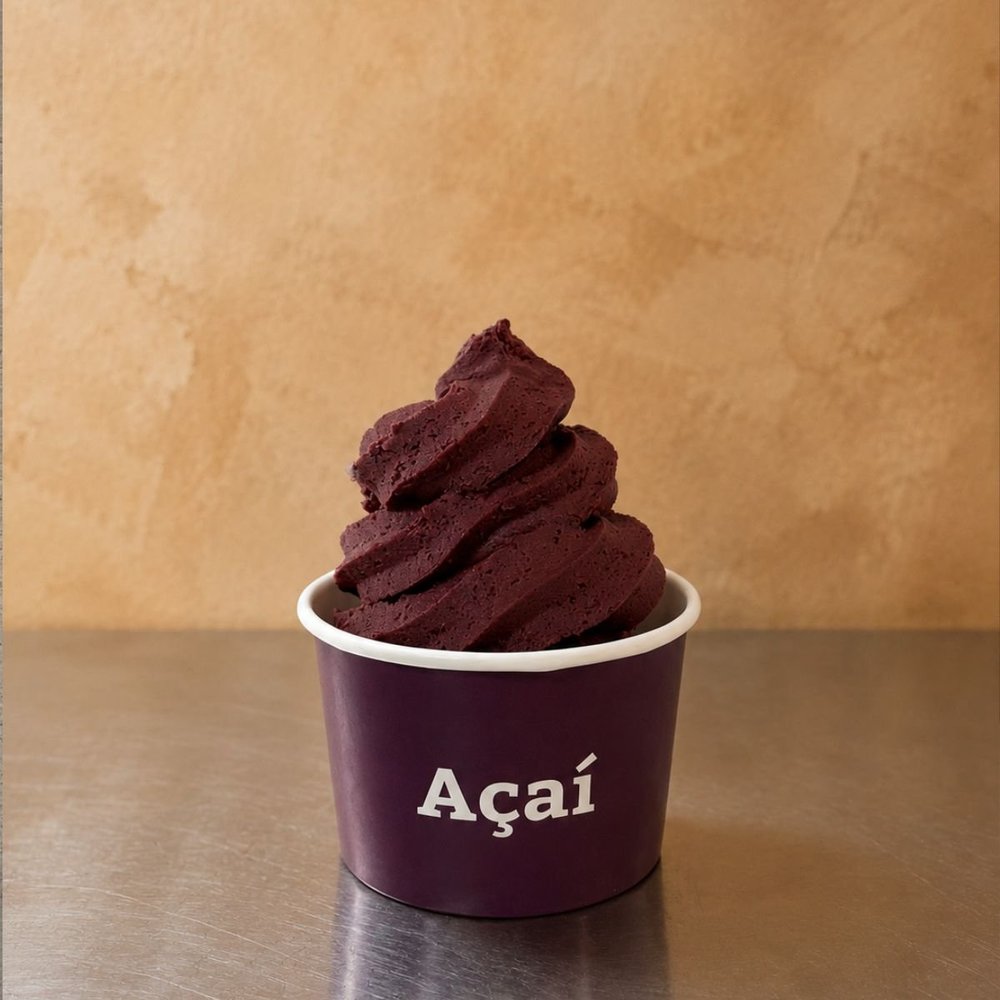
The machine starts to pay for itself when sales spike. An açaí stand makes its money in a few busy hours, and that’s when scooping wears you out: the line is long, your wrist aches, and the portions come out uneven because the person behind the counter is in a hurry. A soft-serve-style machine delivers the same portion every time, in seconds, with just the right consistency.
There are three prizes, in this order:
- Speed during rush hour. Flere solgte bowls i de timene som faktisk betyr noe.
- Consistent portions. Portion control is hidden profit—if you scoop out 20 grams too much, your profit margin disappears without anyone noticing.
- The presentation. A machine-made swirl looks just like the picture on the wall. It sounds superficial, but in a category where people take photos of their food, that’s what sells.
And when isn't it worth it? If your volume is low and evenly spread out throughout the day, if you're only open during the summer season (and have decent traffic), or if you don't have the space or power outlet for it. In those cases, the machine is a cost with no return, and you should wait. We'd rather tell you this now than after you've bought it.
A good rule of thumb: start using a calculator when you’re selling so much that the staff at the stand can no longer keep up with the rush, and the whole crew starts to feel physical strain from scooping açaí.
Equipment and Space
Aside from a storefront or retail space with an attached refrigerated and frozen food storage area, an açaí concept requires surprisingly little:
- A freezer with enough room for buckets—this is often the real limitation in a small space. It's always nice to have extra storage and extra freezer space.
- A topping station with chilled bowls. This sells more than you'd think: choice is half the experience.
- Counter space for making bowls.
- Machine—once you get there. Check the dimensions, power requirements, and distance from the wall before you sign the lease, not after.
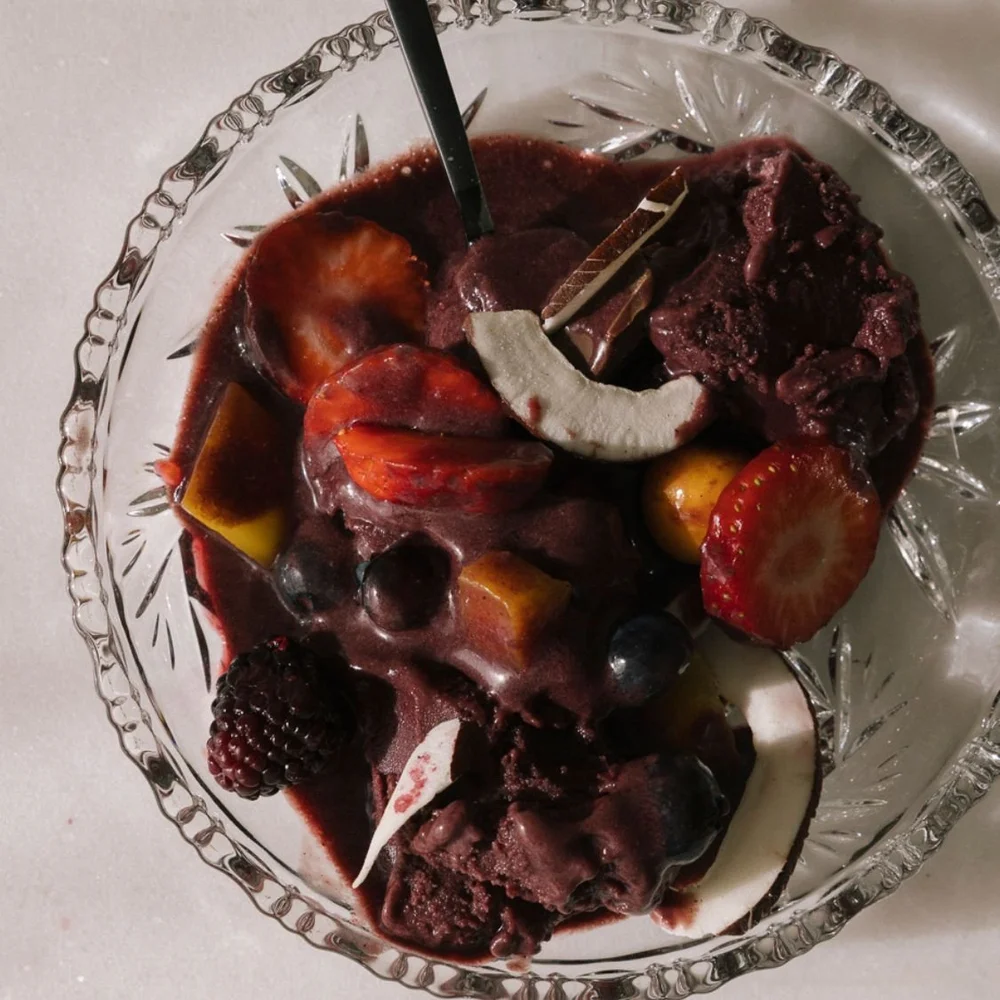
- Packaging suitable for photography. The bowl is photographed. The cup is your marketing tool. Keep in mind that there may be different sizes for “eat now” and “take home.” For example, a 750-ml paper cup with a lid might be perfect for taking home and putting in the freezer for a special occasion, compared to a 100–200-ml cup meant to be eaten right away.
Winter is the real test
Let's be clear: açaí is a year-round product, but you have to do it right. You have to show that it is, and you have to show that it works for a variety of occasions and times of day.
This is why Norwegian açaí concepts fail, and it’s almost never because of the product itself.
Açaí sells itself in June. In January, it doesn’t sell at all—unless you’ve given people another reason to come in—remind them that it’s perfect right now, too, with a cup of coffee, with a blanket, as a snack, or as dessert. Think like your customers. Those who make it through the winter usually do one of the following:
- Shakes and smoothies made with the same ingredients and the same machine—warmer colors, larger portions, higher price.
- Protein as a selling point. Açaí with a protein topping appeals to the fitness crowd, and gyms are neighbors worth getting to know.
- Breakfast, room service, lunch, and snacks. Bowls are a full-fledged meal. If they're priced as such, you'll be able to enjoy them at a completely different time of day.
- Drinks. An açaí cocktail, or a scoop of açaí with salted caramel sauce and a brownie — with a drink in hand.
- A pure dessert. Açaí is purple—a perfect Advent color—and serves as the "ice cream" on the menu.
- Delivery. Wolt and Foodora take their cut, but they do so on a sale you wouldn't have made otherwise.
Plan for winter before you open in the spring. That's the one order that matters.
The mistakes we keep seeing
- No social media, or very little.
- No or very little on-site marketing.
- Crystallization. The product must be perfect when the customer visits for the first time; otherwise, they won't come back. Make sure the product is thawed perfectly before serving.
- The space is too big. Rent is the only expense that doesn't depend on how many bowls you sold today.
- The menu is too broad. Twelve variations result in twelve different ingredients being wasted. Four good variations sell better.
- Cheap açaí. There are more affordable options on the market, and they taste accordingly. A bowl is sold once on price and ten times on taste.
- It's too early to buy this machine. Buy it when your workload calls for it, not just because it looks nice.
- No winter plan. See the section above. This is the most expensive of them all.
- I'm not going all in.
FAQ – How to Start an Açaí Business
How much does it cost to start an açaí bar?
It depends almost entirely on the space, kiosk, or food truck you choose. The actual production equipment is modest compared to a kitchen—it’s the rent, furnishings, and staffing that make the difference. A corner in an existing business can be started for very little, while a separate space in a shopping center is a completely different investment.
Do I need a machine to sell açaí bowls?
No. Most people start by scooping from a bucket. The machine is a tool for measuring volume, not a requirement.
How many bowls can I get from one bucket?
Our sorbet comes in 3.79-liter tubs. That makes about 25 servings at 150 ml per serving, and about 19 at 200 ml per serving.
What sales tax rate should I use?
15 percent for takeout, 25 percent when the guest eats in. If you offer both options, the point-of-sale system must distinguish between them.
Can I sell açaí without having my own storefront?
Yes—stalls, food courts, festivals, and pop-ups are common ways to test a concept before committing to a lease.
Would you like to bounce ideas off someone before you start an açaí business?
We supply açaí, toppings, and equipment to restaurants throughout Norway, and we're here to offer helpful advice and guidance before you get started.
Get in touch, and we'll find the recipe for success that's right for you.
Isdalen AS delivers only to businesses and restaurants, not to private individuals.